

Key Takeaways:
- Older homes built before the 1980s carry a high risk of containing asbestos in materials (ACMs) like insulation, roofing, and flooring.
- Professional testing is the only definitive way to confirm any presence, as visual inspections and DIY kits are highly unreliable.
- DIY testing risks dangerous fiber contamination and is not legally sufficient for securing permits.
- Professional surveys provide the required legal documentation and comprehensive sampling necessary to protect homeowners from future liability.
- Exposure to disturbed fibers causes severe, long-term health conditions, including asbestosis, lung cancer, and mesothelioma.
Does Your Home Have Asbestos?
People once regarded asbestos as a miracle material because it resists heat, is affordable, and lasts a long time. However, in the decades since it became a popular building material, we’ve learned that exposure to it can cause serious health problems. These include asbestosis, lung cancer, and mesothelioma.
So, how do you know if you have it in your home? This guide is designed to help you understand your risk factors and whether it’s worth it to get asbestos testing.
How To Tell If You Have Asbestos? Start with Your Home’s Age
Asbestos is no longer used as a building material – and hasn’t been for a long time. But there’s still a ton of it out there. It’s found in older homes. So, if you’re living in a house that was built before the 1980s, there’s a chance it contains asbestos.
Asbestos was used from the late 1800s until the 1980s, with the heaviest usage coming during the period from 1940 to 1980. It was commonly found in building materials like insulation, floor tiles, and roofs. So it’s important to check your home’s age to see if it might be present.
What Does Asbestos Actually Look Like?
Asbestos can be difficult to identify just by looking at it. However, there are some telltale signs. Depending on where you’re looking, here’s what it might look like:
| Material | Appearance |
|---|---|
| Insulation | Often appears as a gray or off-white, fibrous material. |
| Floor Tiles | Typically 9×9 inches and may have a white, brown, or gray color. |
| Pipe Insulation | May resemble a corrugated paper-like material or be wrapped in a canvas-like fabric. |
Should I Test for Asbestos Myself?
Your home’s age and visually inspecting materials can give you some idea of whether you have asbestos, but it’s no replacement for testing. Testing is the only way to confirm the presence of asbestos.
So no, you should hire a professional company to handle asbestos testing for you. While the “do-it-yourself” spirit is a hallmark of home ownership, there are several important reasons testing isn’t a good DIY project. DIY testing does not stack up to professional asbestos testing in these ways:
Reason #1: Legal Compliance – DIY Asbestos Testing Is Not Legally Sufficient
Most local jurisdictions and building departments in Portland OR, Vancouver WA, and Salem OR require a survey performed by a certified professional before they will issue a demolition or renovation permit.
Contractors also require hiring an AHERA building inspector to collect the sample (all of our inspectors are AHERA certified). This is a requirement in both Oregon and Washington.
- Permit Requirements: Building departments rarely accept DIY lab results for permit applications.
- Regulatory Standards: Professionals follow EPA and OSHA-mandated sampling protocols that DIY kits do not account for.
- Official Documentation: A certified report is a legal document; a DIY result is simply a piece of paper.
Oregon and Washington – Asbestos Testing Regulations
Know your local rules to stay compliant. It’s important to understand your rights and duties as a homeowner.
| State | When Testing Is Required | Required Inspection |
|---|---|---|
| Oregon | Commercial and residential buildings built before January 1, 2004; necessary before demolition or renovation. | Survey conducted by an accredited inspector; report must stay on-site and be available for the DEQ. |
| Washington | All buildings regardless of age; applies to homeowners, contractors, and HOAs before any construction or repair. | Good-faith inspection by an AHERA-certified building inspector; requires notification and specific training for supervisors. |
Reason #2: Safety Risks – Even Minor Exposure Is Hazardous
The moment you scrape a piece of popcorn ceiling or cut into floor tile, you risk releasing millions of fibers into your living space. Without industrial-grade HEPA vacuums, specialized wetting agents, and personal protective equipment (PPE), a simple DIY sample can contaminate an entire HVAC system.
- Fiber Release: A single disturbed “pinch” of insulation can contaminate a room.
- Cross-Contamination: Walking through a “hot” zone can spread fibers to carpets and furniture in other rooms.
- Professional Containment: Atlas Labs, Inc. uses specific techniques to seal the sampling area, ensuring your air remains breathable.
Reason #3: Accuracy – DIY Tests Get It Wrong
Asbestos isn’t always distributed evenly throughout a material. It is often found in specific layers, such as the mastic (glue) behind a tile or the paper backing on linoleum. A homeowner might sample the top layer of a floor and receive a “negative” result, while the toxic material remains hidden just a millimeter below.
- Layered Sampling: We test every component of a material—from the base layer to the finish.
- Representative Samples: We know how many samples are statistically required to “clear” a room, whereas a DIY kit usually only tests one spot.
- Lab Reliability: Professional samples are sent to NVLAP-accredited laboratories that specialize in polarized light microscopy (PLM).
Reason #4: Liability – Professional Testing Reduces Your Risk
If you sell your home in Portland OR, Vancouver WA, and Salem OR, you will likely be required to disclose known hazards.
If you performed your own testing and missed a pocket of asbestos that a future owner discovers during a remodel, you could be held liable for their exposure and the subsequent abatement costs. A professional report provides a “paper trail” that serves as an insurance policy for your reputation as a seller.
Reason #5: More Economical – Professional Testing Answers the Question Right Away
It seems cheaper to buy a $40 kit, but mistakes are expensive. If a DIY test comes back “inconclusive” or if you realize halfway through that you didn’t sample the sub-flooring, you end up paying for a professional anyway.
Furthermore, if you accidentally contaminate your home, the cost of “cleaning” the air and surfaces is significantly higher than the initial cost of a professional survey.
Leave your information below and we will be in touch! Leave your information below and we will be in touch! "*" indicates required fieldsSchedule Your Environmental Testing Today!

When Can You Test for Asbestos Yourself?
DIY testing isn’t totally without use, but it is important to be clear about your goals. Essentially, a DIY kit can tell you “Yes, there is asbestos,” but it can almost never safely or accurately tell you “No, there isn’t.”
While you should still get professional testing in most scenarios, you might consider a DIY kit for:
- Preliminary Information Only: If you are simply curious about a material in your home and have no immediate plans to disturb it, a kit can satisfy that curiosity. However, this should never replace a professional survey before a renovation.
- Testing for “Positives” Only: In the world of home testing, a “positive” result for asbestos is generally reliable. If the result says it’s there, it’s there. However, you should never assume a “negative” result in a DIY test means your home is clear. A negative result may result from a sampling error.
- The Property is Vacant and Stripped: If you are working in an empty building where no one is living or breathing the air, and you have invested in professional-grade PPE (N-100 or P-100 respirators), the risks of accidental secondary exposure to others are lower.
- Identifying Specific “Suspect” Loose Items: If you have a loose, manageable item — like a stray piece of old pipe wrap found in a box in the garage — you may be able to test that item safely without disturbing the air in your living space.
Stay Informed: Know the Health Risks of Asbestos Exposure
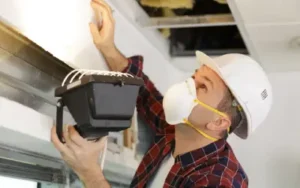 It’s important to know the health risks of asbestos exposure. This knowledge helps you take the right precautions. Long-term exposure to fibers can cause serious health problems, such as:
- Asbestosis: A chronic lung disease characterized by scarring of lung tissue, leading to breathing difficulties and an increased risk of lung infections.
- Lung Cancer: Asbestos exposure increases the risk of developing lung cancer, especially among smokers.
- Mesothelioma: A rare and aggressive form of cancer that affects the lining of the lungs, chest cavity, and abdomen. Mesothelioma is almost exclusively linked to exposure.
Stay informed about the hazards of asbestos exposure. Take action to protect yourself and your loved ones from its dangerous effects.
Preventive Measures: How to Minimize Asbestos Exposure
To reduce the risk of asbestos exposure, it’s crucial to take some preventive measures:
- Regular Inspections: Schedule periodic inspections by a professional inspector, especially if your home was built before the 1980s.
- Proper Maintenance: Keep ACMs in good condition by avoiding damage or disturbance. For example, avoid drilling or cutting into walls or floors that may contain asbestos.
- Encapsulation: If it is present and in good condition, encapsulation can help seal the material and prevent fibers from becoming airborne. This method involves applying a specialized coating or barrier to the asbestos-containing material.
- Professional Removal: If asbestos is damaged or deteriorating, the safest course of action is to have it removed by a licensed abatement company.
How Does Our Testing Process Work?
We understand you’re busy and your time is valuable – that’s why we make our asbestos testing process as easy and straightforward as possible. Here’s how it works:
- Collect a Sample: You can collect the sample yourself or call us to come collect a sample for you.
- Sample Drop-Off: If you collected it yourself, simply bring it to one of our convenient drop-off locations. If our team collected the sample, we’ll take it to begin testing.
- Results Delivered: We’ll send you your accurate results. Standard processing time is a couple of days, but we offer same-day or next-day results if you’re in a rush.
Have a sample ready for testing? Find a sample drop-off location near you.
Call Us for Fast and Accurate Asbestos Testing You Can Trust
Don’t leave your family’s health or your property’s value to chance. At Atlas Labs, Inc., we provide the residents of Portland OR, Vancouver WA, and Salem OR with comprehensive, certified asbestos testing and post-abatement clearance testing that meet all legal requirements and safety standards.
Call us today to schedule your testing. We take the guesswork out of your renovation, providing you with a clear, accurate report that lets you move forward with confidence.
FAQs About Looking for Asbestos in Your Home
How do you know if you have asbestos in your walls?
It’s challenging to determine if your walls contain asbestos just by looking at them. The best way to know for sure is to hire a professional inspector who will take samples and have them analyzed in a lab.
How much does asbestos removal cost?
The cost of asbestos removal varies depending on the size of the project and the specific materials involved. Typically, removal can range from a few hundred to several thousand dollars. It’s essential to get multiple quotes from reputable companies to find the best value.
Is it dangerous to live in a house with asbestos?
As long as the ACMs are in good condition and not disturbed, the risk of exposure is minimal. However, if the materials are damaged or disturbed, it’s essential to address the issue immediately to reduce exposure risk.
Have more questions? Be sure to check out our comprehensive asbestos testing FAQs here.