
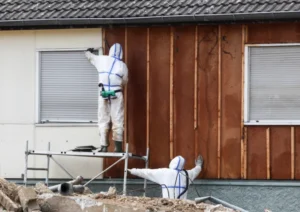
 Exactly when you need post-abatement clearance testing depends on several factors, including the type of hazardous material involved, whether your property is residential or commercial, and the specific regulations in Oregon and Washington. But the general rule is simple: schedule your clearance assessment as soon as the remediation work is finished, but before anyone re-enters the space or before containment barriers are removed.
A post-abatement clearance assessment is the final step after hazardous materials have been professionally removed from your property. Think of it as the official “all-clear” that confirms the remediation work was successful. This independent testing verifies that the air and surfaces in your property meet safety standards and are free from dangerous contamination.
It must be performed by a third-party testing company, not the same contractor who performed the abatement work. This separation exists to protect you. It ensures there’s no conflict of interest and that your results are completely unbiased. One company does the work, and a separate expert firm verifies that the work was done correctly.
How Soon After Remediation?
For asbestos projects, clearance testing should happen immediately after the abatement contractor has completed their work and performed their final cleaning.
The containment barriers must remain in place until the clearance test passes. If you wait too long or allow people to enter the area, you risk contaminating the space and having to start the cleaning process over.
For lead abatement, the clearance assessment should be scheduled as soon as the abatement contractor notifies you that the work is complete.
The area should not be disturbed between the completion of abatement and the clearance testing. Our technicians will conduct a visual inspection first, then collect dust wipe samples from floors, window sills, and other surfaces.
For mold remediation, timing depends on the drying process.
The remediated area must be completely dry before clearance testing can accurately assess the results. Your remediation contractor should tell you when the space is ready for testing, which is typically 24 to 48 hours after the final cleaning and drying procedures are complete.
Other Legal Requirements
Asbestos Remediation Clearance Testing Requirements
Both Oregon and Washington have strict regulations governing asbestos removal and the testing that must follow. You’ll need asbestos remediation clearance testing immediately after the abatement contractor has finished their work and before anyone returns to the space. The area must remain sealed until testing confirms it passes clearance standards.
In Oregon, the Department of Environmental Quality (DEQ) oversees asbestos regulations. Commercial and public building projects involving asbestos abatement require clearance testing before the area can be reoccupied. The Oregon DEQ follows EPA protocols, which mandate that an AHERA-certified inspector conduct the final clearance assessment.
Washington State has similar requirements under the Department of Labor & Industries and the Department of Ecology. Any project involving more than a small amount of asbestos-containing material requires proper abatement procedures followed by clearance testing.
Lead Remediation Clearance Testing Requirements
Federal law provides clear guidance here. The EPA’s Renovation, Repair, and Painting (RRP) Rule requires that any work disturbing lead-based paint in homes built before 1978 must be performed by certified renovators. Following this work, a clearance examination is required for many projects.
In Oregon and Washington, lead clearance testing is mandatory for most abatement projects in pre-1978 housing where children under six years old reside or where the property receives federal housing assistance. This includes rental properties, childcare facilities, and public housing.
For commercial properties, the Occupational Safety and Health Administration (OSHA) sets requirements for worker safety during and after lead abatement. Clearance testing helps demonstrate compliance with these regulations and protects both workers and future occupants.
Mold Remediation Clearance Testing Requirements
Unlike asbestos and lead, mold remediation is not as heavily regulated at the federal level. Neither Oregon nor Washington currently has state licensing requirements for mold remediation contractors or mandatory clearance testing laws for most residential projects.
For commercial properties, many building codes and lease agreements require proof that indoor environmental quality meets acceptable standards. Schools and healthcare facilities often have additional requirements for air quality verification after any remediation work.
Air Quality Testing After Remediation
Air sampling is performed to detect microscopic fibers that may be invisible to the naked eye. This involves using fans to stir the air and dislodge any particles that may have settled on surfaces during the abatement process.
For asbestos clearance, air samples are analyzed using Phase Contrast Microscopy (PCM). The area only passes when the airborne fiber concentration falls below 0.01 fibers per cubic centimeter. This standard ensures the air is safe to breathe.
Leave your information below and we will be in touch! Leave your information below and we will be in touch! "*" indicates required fieldsSchedule Your Environmental Testing Today!

When It’s Not Legally Required, Why Get Clearance Testing At All?
Here’s our perspective as environmental testing professionals who have seen countless situations unfold over the years: Health and safety should always come first. Hazardous materials like asbestos fibers, lead dust, and mold spores are often invisible. You cannot tell by looking at a space whether it’s truly safe. Professional testing using laboratory analysis provides certainty that visual inspection alone cannot offer.
Legal protection is another compelling reason. If someone later claims they were harmed by exposure to hazardous materials on your property, having clearance documentation demonstrates that you took appropriate steps to ensure safety. Without this documentation, you have no proof that the remediation was successful.
Property value and marketability also come into play. Buyers and tenants increasingly ask about environmental testing and remediation history. Being able to provide clearance documentation can make your property more attractive and easier to sell or rent.
And after going through the disruption and expense of a remediation project, knowing with certainty that the job was done right allows you to move forward confidently.
What Happens If My Property Fails Clearance Testing?
If a clearance assessment fails, the abatement contractor must return to re-clean the area. They’ll address whatever issue caused the failure, whether that’s remaining debris, elevated dust levels, or airborne fibers above acceptable limits.
After the contractor completes the additional cleaning, the clearance process must be repeated. This cycle continues until the property meets all safety standards.
While this can add time to your project, it’s the only way to make sure the space is truly safe.
Work With Atlas Labs, Inc.
Getting your post-abatement clearance assessment doesn’t have to be complicated. As an independent environmental testing laboratory, Atlas Labs, Inc. serves clients throughout Oregon and Washington.
Our team of highly trained and certified technicians uses state-of-the-art equipment to deliver fast and accurate results you can trust. We work directly with you and your abatement contractor to schedule the assessment as soon as the work is complete. This coordination helps minimize delays and gets your project back on track faster.
All of our air clearances follow the NIOSH 7400 method and adhere to EPA and DEQ protocols for aggressive air clearance sampling. This means your results meet the highest standards and will be accepted by regulatory agencies, insurance companies, and other parties who may need to review your documentation.
Our team is ready to answer your questions and help you get the all-clear for your property. Contact Atlas Labs, Inc. today to schedule your post-abatement clearance assessment.