
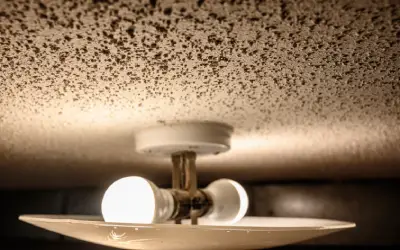
 Are you planning home renovations? Asbestos testing is not just a general safety recommendation; it is a prerequisite for pulling municipal building permits, securing bids from licensed contractors, and preventing site contamination. Before you pull up old linoleum, scrape acoustic ceiling texture, or tear down drywall, verifying whether those materials contain asbestos is a strict statutory mandate.
Atlas Labs, Inc. provides the accurate lab testing and certified documentation your project requires. From rapid Polarized Light Microscopy (PLM) bulk sample analysis for DIY drop-offs to comprehensive on-site AHERA surveys for permitted contractor remodels, we ensure your home renovation begins legally and safely.
Oregon vs. Washington Renovation Laws: When Do You Need to Test?
State environmental and occupational safety laws strictly regulate structural alterations. The requirements vary based on your location and who is doing the work:
Feature | Oregon | Washington |
Governing Agency & Rule | Oregon DEQ (OAR 340-248) | Washington L&I (WAC 296-62-07721) & Regional Clean Air Agencies |
Applicable Build Dates | Structures built prior to January 1, 2004 | Universal (all structures, regardless of year built) |
Required Testing Level | Accredited testing for all suspect materials | Certified AHERA “Good Faith” asbestos inspection |
Work Trigger | Prior to any renovation or demolition | Prior to any mechanical disturbance |
Schedule Your Environmental Testing Today!
Leave your information below and we will be in touch!

Leave your information below and we will be in touch!
"*" indicates required fields
Can You Do Your Own Testing? (The “DIY vs. Hired Contractor” Legal Divide)
- DIY Homeowners: Single-family owner-occupants performing 100% of the renovation work themselves are legally permitted to collect their own bulk samples for laboratory analysis.
- Hired Contractors & Permitted Projects: If you hire a general contractor, plumber, electrician, or demolition crew—or if you are submitting materials to a municipal building department for permits—an on-site survey conducted by an AHERA-certified building inspector is required by law. You are legally prohibited from relying on homeowner sampling
Renovation Planning Timeline: When to Schedule Testing
You must schedule and complete asbestos testing before setting a demolition date or allowing any work to begin. Waiting until project kickoff risks emergency stop-work orders and severe regulatory penalties.
Don’t write off testing as an afterthought—it is a mandatory prerequisite that must be completed during your earliest planning phase to secure building permits and account for state-mandated notification waiting periods if abatement is required.
Phase 1: Pre-Design & Scoping (4–6 Weeks Before Demo)
Conduct a visual walk-through of the project footprint. Identify all suspect materials that will be impacted by the new floor plan, plumbing updates, or electrical routing.
Phase 2: Testing & Lab Turnaround (3–4 Weeks Before Demo)
Submit samples or schedule your AHERA inspection. Choose your analysis speed based on your schedule: Same-Day Rush, 24-Hour, 2-Day, or 5-Day Standard turnaround.
Phase 3: Scope Finalization & Permitting (2–3 Weeks Before Demo)
Integrate the certified lab documentation into your contractor’s scope of work or attach it to your municipal permit application packages to ensure swift approval.
Phase 4: Abatement vs. Direct Demo (1–2 Weeks Before Demo)
If tests return positive, factor in state notification periods. DEQ and regional Clean Air Agencies require up to a 10-day waiting period before a certified abatement contractor can begin removal.
Room-by-Room Guide: High-Risk Disturbance Zones
At its peak, asbestos was utilized in over 3,000 different building products. During a home remodel, pay close attention to these high-risk zones:
- Kitchens & Bathrooms: Vinyl sheet flooring (specifically the friable paper backing), vinyl composition tiles (VCT), multi-layered black cutback mastic, sink sound-deadener coatings, drywall joint compound, and wall texture.
- Basements & Utility Closets: Ductwork thermal paper wrap, pipe elbow insulation, furnace gaskets, and structural transite heat shields surrounding older HVAC units.
- Living Areas & Bedrooms: Acoustic “popcorn” ceiling texture, plaster skim coats, artificial fireplace embers, and HVAC register boots.
- Exteriors & Additions: Fiber-cement siding shingles (transite), window caulking and glazing putties, and roofing underlayment or mastics.
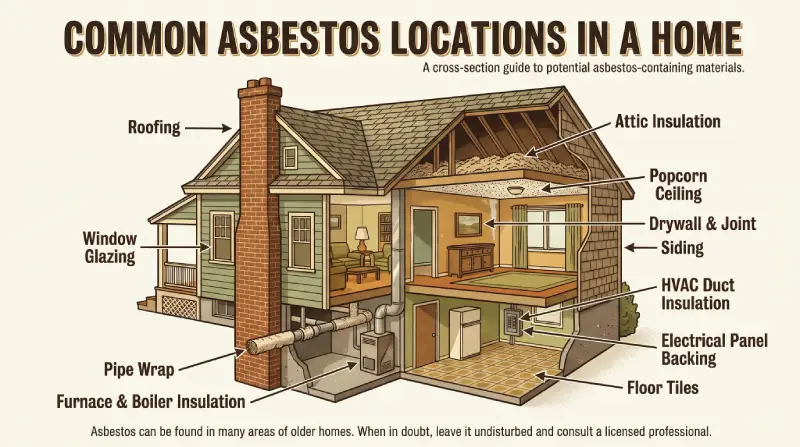
Disclaimer: This graphic is for illustrative purposes only. This guide highlights common risk areas in older homes but is not exhaustive, and asbestos cannot be identified by sight alone. Always consult a certified asbestos inspector for laboratory testing before disturbing any suspected materials.
Testing Pathways: Lab Drop-Off vs. On-Site Inspection
We offer two convenient options for testing your home prior to renovations. Choose the testing pathway that aligns with your project scope and legal requirements:
Option A: Self-Collected Drop-Off / Mail-In Testing
- Best for: Owner-occupants conducting isolated DIY repairs (e.g., scraping a single room’s popcorn ceiling or pulling up a small section of flooring).
- The Process: The homeowner safely extracts a 1–2 square inch sample of the material using the wet method (capturing all layers down to the substrate), double-bags the material, completes a Chain of Custody (CoC) form, and drops it at our lab for PLM analysis.
For more information, check out our article on how to collect an asbestos sample.
Option B: Full-Scope On-Site AHERA Inspection
- Required for: Whole-home renovations, contractor-managed remodels, additions, and projects requiring official permit sign-offs.
- The Process: One of our state-licensed, AHERA-certified building inspectors arrives at your property to perform a comprehensive survey, identify all suspect materials, safely extract core samples, and generate a legally defensible pre-renovation report.
Interpreting Your Lab Report: Navigating the Results
Once analysis is complete, your report will classify the materials to dictate your next steps.
- Negative Result: The material contains 1% or less asbestos. You have documented legal clearance to proceed with standard demolition and disposal.
- Positive Result (ACM): The regulatory definition of an Asbestos-Containing Material (ACM) is any material containing greater than 1% asbestos via Polarized Light Microscopy (PLM). You must not disturb the material. You will need to hire a certified abatement contractor for safe, compliant removal before the rest of your renovation can proceed.
- Secondary Testing for Trace Results: If a sample yields a “trace” amount (less than 1% but greater than 0%), standard protocol dictates running a 400-Point Count PLM or Transmission Electron Microscopy (TEM) analysis. This high-resolution secondary testing definitively proves whether the material is legally regulated, often saving homeowners thousands of dollars in unnecessary abatement costs.